
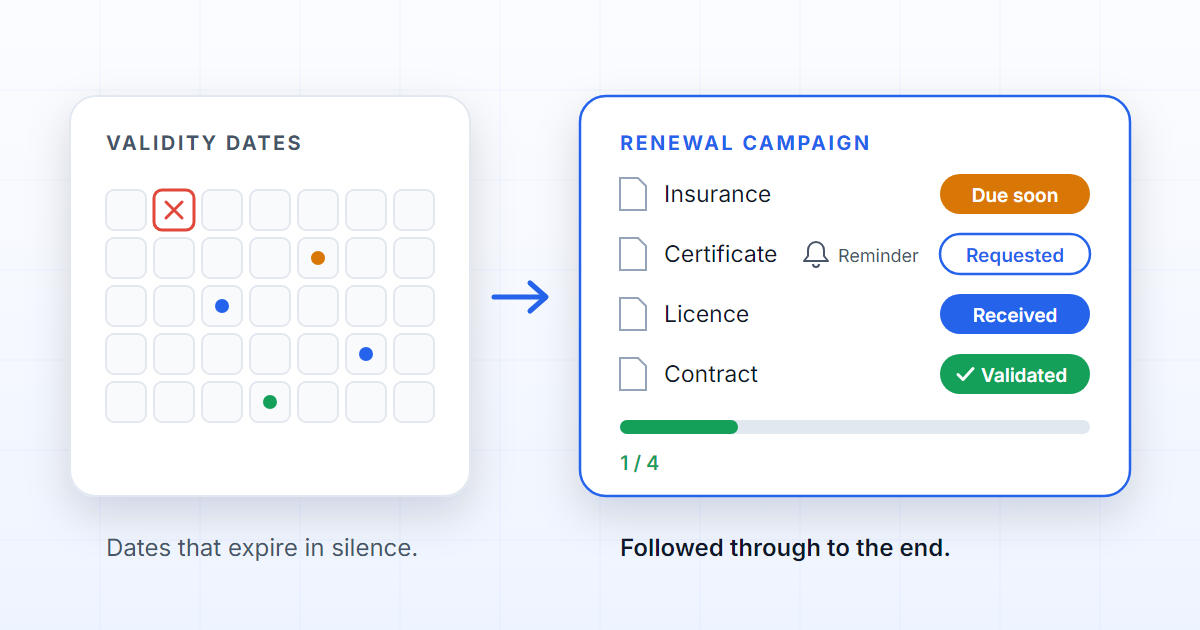
A document valid today can be a risk tomorrow. Certificates, insurance policies, licences, proofs, declarations and contracts have deadlines, and managing document validity means turning those dates into work — warnings, requests, deliveries, reminders and proof of renewal — attached to the process the document belongs to. If the system only stores the file, the organisation discovers the expiry too late: when it needs the document, when an auditor asks, or when an operation fails.
Why documents expire in silence
Most teams handle validity with spreadsheets, calendars and memory. Somebody notes a date, somebody else sends an email, a reply arrives with an attachment, somebody updates the folder. Each step is small; together they form a fragile chain.
To be fair to the tools: a spreadsheet is a good list, a calendar reminds one person of one date well, and email is how you ask somebody outside for something. What none of them knows is that the date in a cell is one supplier's insurance, living in one dossier, where the reply with the attachment should have been filed.
The problem is not that the validity date exists. The problem is that it is not connected to the process.
What a renewal campaign should do
A document renewal campaign is a piece of work with a beginning and an end. It should:
- identify the documents about to expire, with the right lead time for each kind;
- group the requests by person or organisation, instead of one email per document;
- send reminders, and escalate when the deadline nears with no answer;
- receive the new versions and attach each delivery to the right dossier and document;
- leave evidence of everything: what was requested, from whom, when, what arrived and who validated it.
It should also respect exceptions, or it produces wrong requests at scale: documents replaced in the meantime, people who have left, closed processes whose documents are a record, not pending work, lead times that differ by document type, and confidential documents that cannot travel through any channel.
Renewing is more than notifying
A notification says "something is about to expire". An operational campaign carries the renewal through to the end: it knows whom to ask, which document to expect, which deadline applies, when to remind, when to escalate — and, above all, when the work is finished.
| Reminder | Operational campaign | |
|---|---|---|
| What it knows | A date and an address | The document, the dossier, who delivers and by when |
| When it ends | When it is sent | When every document is renewed or closed as an exception |
| Where the tracking lives | In the recipient's inbox | In a governed list, per person and per document |
| What remains as proof | A sent email | Request, reminders, delivery and validation, each dated |
| An exception | Nobody notices it | Recorded, with a reason |
The result is not an inbox full of requests but a governed list of dossiers and documents that need action, each row saying where it stands — due soon, requested, received, validated — and who has the next move.
What exists in DOK Genius today
In DOK Genius, validity and expiry belong to the document inside the dossier, like the rest of its document-governance features. Each process declares which of its documents carry a validity date and how many days ahead to warn; when a dossier is opened, that declaration travels with it. That is what lets renewal be treated as a document process rather than a loose reminder. The manual explains how to work a dossier and what each document state means.
From there, a screen lists the documents expiring: one row per document, not per dossier, because it is the document that expires. The rows sit in three windows — expired, within 30 days, 31 to 90 days — deliberately not added together: an emergency, this month's work and a planning figure ask for different things. From that list, without opening the dossier, you renew the validity when only the date changed, or replace the file when the new one arrives. Documents in a closed dossier are listed but cannot be changed: they are a record.
What is on the roadmap
What does not exist yet is the campaign: today the screen shows what is about to expire and lets you act on each document, but the request, the reminders and the follow-up happen outside. Document renewal campaigns are on the roadmap, and the promise is clear: expiring documents become campaigns that can be followed, with requests grouped per person, deliveries that land in the right document of the right dossier, automatic reminders, per-person tracking and external delivery by invitation, so that whoever has to renew delivers the new file without an account.
A campaign built on a spreadsheet inherits the fragility of the spreadsheet; built on the dossier, it inherits its structure. The public roadmap shows where each piece stands.
FAQ
What is the difference between a reminder and a renewal campaign?
A reminder is a message on a date: it ends when it is sent. A campaign is a piece of work: it knows which document it expects, from whom and by when, keeps asking until it arrives, files the new version in the right place and leaves proof of every step. A reminder can be part of a campaign; it never replaces one.
How far ahead should a document renewal be requested?
It depends on how long the new document takes to obtain, not on how long the old one remains valid: a certificate issued in minutes is requested two or three weeks ahead; an insurance policy or a licence that depends on third parties, one to two months. The lead time is set per document type, in the process.
What should be done about expired documents in dossiers that are already closed?
Do not change them. A closed dossier records what was true when the decision was taken, and a record that gets edited stops being one. If the relationship continues, the renewal belongs to an active dossier.
Are renewal campaigns available in DOK Genius today?
Not yet. Today there is a validity date per document, a warning with the lead time set in the process, and the documents expiring screen, where you renew a validity or replace a file. Requests, deliveries, reminders, per-person tracking and external delivery by invitation are on the roadmap.