
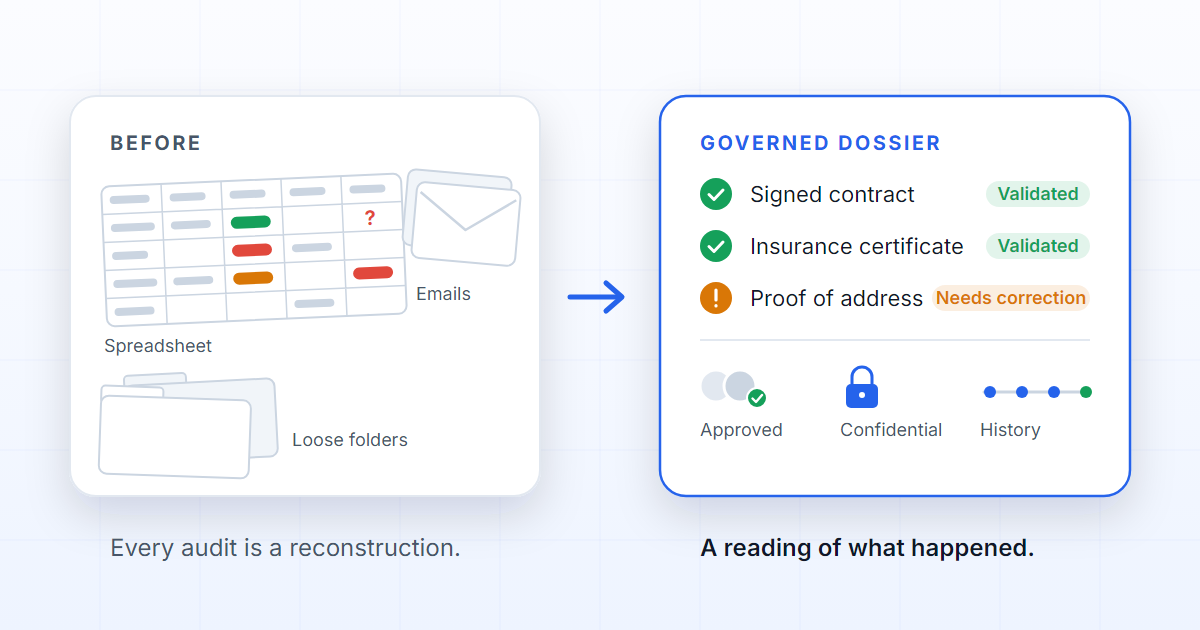
Many compliance teams end up building a second reality outside the official systems. The documents sit in folders. The dates sit in a spreadsheet. The decisions sit in email threads. The exceptions sit in loose comments. When an audit arrives, the organisation has to reconstruct the story piece by piece.
The problem is not a lack of effort. It is the lack of a document structure that ties process, documents, states, decisions and evidence together — which is what document governance means in practice. Without it, the team reconciles; with it, the team reads.
DOK Genius was designed for that kind of work: turning document processes into governed dossiers, where every expected document has a state, a context, a history and a link to the decision it supports.
Why parallel spreadsheets appear
A spreadsheet usually appears because the document system answers only part of the problem. It stores files — and does that well, with versions and search — but it does not clearly show which document was mandatory, whether it was validated, which field was confirmed, who approved it or which exception is still open.
So the team adds columns: status, dates, owners, notes. At first it looks simple. Then it becomes one more source to reconcile: the file in the folder may not be the version the "validated" column describes, and the approval email may have arrived after the row was ticked.
None of this is carelessness. Excel is flexible and a new control takes five minutes to set up; email is where the conversation already happens. The fragility is in asking them to be the source of truth for a process that runs somewhere else — a control that exists only while somebody is paying attention, and that is the kind of control an auditor learns to distrust.
What compliance has to prove
In a regulated document process, the organisation has to answer concrete questions — with records, not with memory. DOK Genius concentrates the answers in the dossier itself:
| Question | Where it usually lives | In a governed dossier |
|---|---|---|
| Which documents were required? | A checklist, or somebody's memory | In the process, copied into the dossier when it is created |
| Which were received, and when? | The folder, counted by hand | In each document's status: missing, partial, uploaded |
| Which version was validated, and by whom? | The "OK" column of the sheet | In the validated status, with author and date |
| Who had access? | Nobody knows for certain | In permissions and confidentiality levels |
| Who approved or rejected? | An email thread | In the approval chain, with decision, date and comment |
| Which exceptions were reviewed? | Loose comments | In Quality Review, with the reason behind each decision |
| What was decided, and on what evidence? | Reconstructed afterwards | In the dossier's history, in the order it happened |
Which documents are required, what state each one is in, who may open it and what has happened to it: compliance is the moment those four questions stop being theoretical.
How a governed dossier answers
A dossier is born from a process that declares the expected documents, so it already knows what it is missing before any file has been uploaded. The list is copied into the dossier rather than referenced — a process edited next quarter does not rewrite what last quarter's cases were asked for, which is what an audit wants to confirm.
Each document then carries its own operational status — missing, partial, uploaded, validated, needs correction, expired — separate from the state of the dossier. An expired certificate is flagged as such even when the case is well advanced; nobody maintains a column of dates to find out. And submission is the first checkpoint: a dossier with a mandatory document missing does not move on, and the message says which one.
AI with traceability
AI can speed up reading documents, extracting fields and preparing summaries. But for compliance, an AI result has to be tied to the permitted sources and to the history of the process.
That is why DOK Genius combines document AI, Quality Review, permissions and auditable evidence. When the process requires it, or when the reading itself raises an exception, the dossier stops in a queue where a person confirms, returns it for correction or rejects it, and every decision carries a reason. The AI proposes; the human decision is recorded, and it is the one that wins.
Permissions apply to the AI as well: an assistant only answers with the documents the person asking is allowed to open. The confidentiality levels and the audit trail are described under Security; confidentiality per document is on the roadmap.
Less reconciliation, more control
When documents, states and decisions live in the same dossier, the team sheds the invisible work of reconciliation. An audit stops being a treasure hunt through email and folders and becomes a structured reading of what happened: who submitted, who validated, who approved, which attachment was replaced and what the external operation returned.
To hand that reading to an external auditor, a compliance evidence pack is on the roadmap: an auditable export of the dossier, with the approved versions, the approvals and an integrity check — see the roadmap. Until then, the history lives in the dossier itself and in the organisation's audit trail, which states the period it retains and says when an export was truncated.
A note on precision: no tool makes an organisation compliant by itself, and that assessment remains the organisation's, together with its legal advisers. What a governed dossier does is make verifiable what was collected, reviewed and decided.
FAQ
Does DOK Genius replace Excel in compliance processes?
In many cases, yes. When the spreadsheet exists to track a process's documents, states, owners and evidence, DOK Genius brings that control inside the dossier itself, where states are computed rather than typed.
Can AI be used in auditable processes?
Yes, provided it works from controlled sources, with human review when needed and enough history to explain the decision. In DOK Genius, the AI reads and proposes; a person decides in Quality Review, and that decision is recorded with its reason.
Can evidence be prepared for an audit?
Yes. The platform keeps the history of documents, states, validations, approvals and exceptions for each dossier, to support internal and external reviews. The exportable evidence pack — approved versions, approvals and integrity in one file — is on the roadmap.