
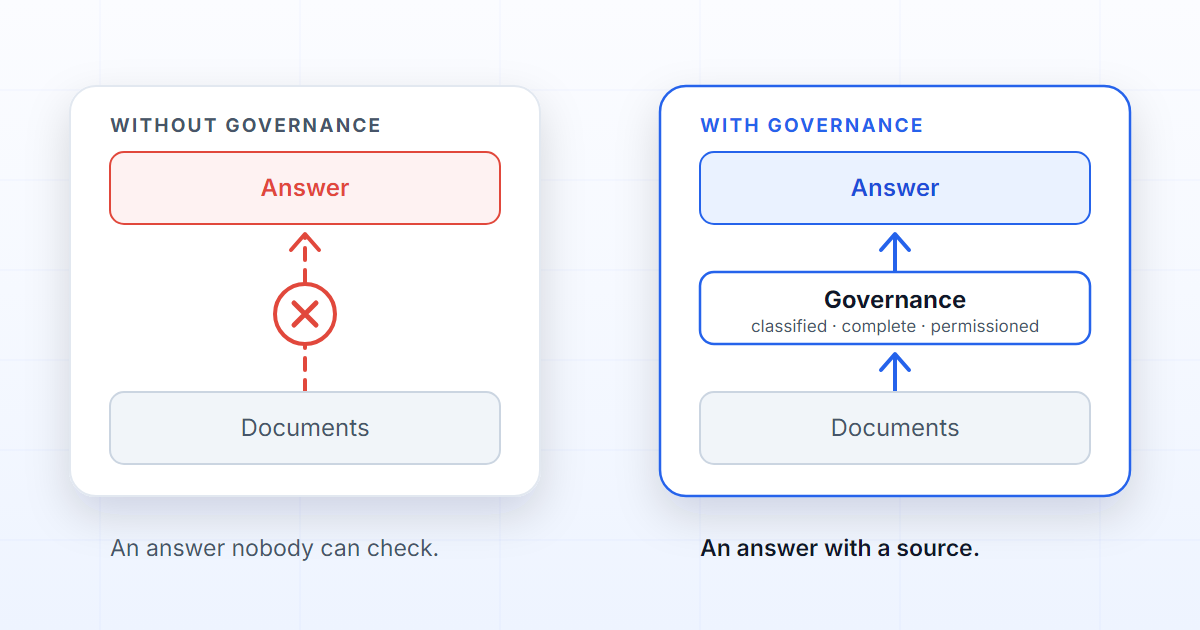
Most teams meet artificial intelligence as a search box. Ask a question, get an answer drawn from everything the company has written down. The demonstration is convincing, and then the pilot meets the shared drive.
The problem is rarely the model. It is that nobody can say which contract is the signed one, whether the insurance certificate on file expired in March, or which of the four folders named after the same client is the one being kept up to date. An assistant reading that will answer confidently from the wrong file, which is worse than not answering at all.
What has to be true first
Three things, and none of them are technical:
- Somebody decided what a complete file looks like. A supplier record needs an identity document, a signed agreement and a valid insurance certificate — not "whatever was sent".
- The documents have a state. Missing, uploaded, validated, needs correction, expired. A document nobody has looked at and a document somebody approved are not the same document.
- The state is maintained by the process, not by memory. An insurance certificate that expires in March has to stop counting as valid in March, whether or not anyone remembers.
That is document governance. It is unglamorous, it predates the current wave by decades, and it is the part that decides whether the search box is useful.
Where DOK Genius sits
A process in DOK Genius declares the documents a case is expected to hold. When a case is opened, those declarations are materialised into a structured dossier: one entry per expected document, each with its own status, its own validity dates and its own approvals. A dossier missing a mandatory document cannot be submitted — the rule is enforced where the work happens, not in a reminder email.
The result is that "is this file complete?" has an answer the system can give, and "which document is current?" is a property rather than a recollection. An assistant reading a governed dossier is reading something that has already been decided, and that is the difference between a demonstration and a tool.
The order matters
Buying the assistant first is the common sequence, and it is the expensive one: the pilot is judged on answers that were never going to be right, and the conclusion drawn is about the model. Govern the documents, and the same model becomes worth its cost.