
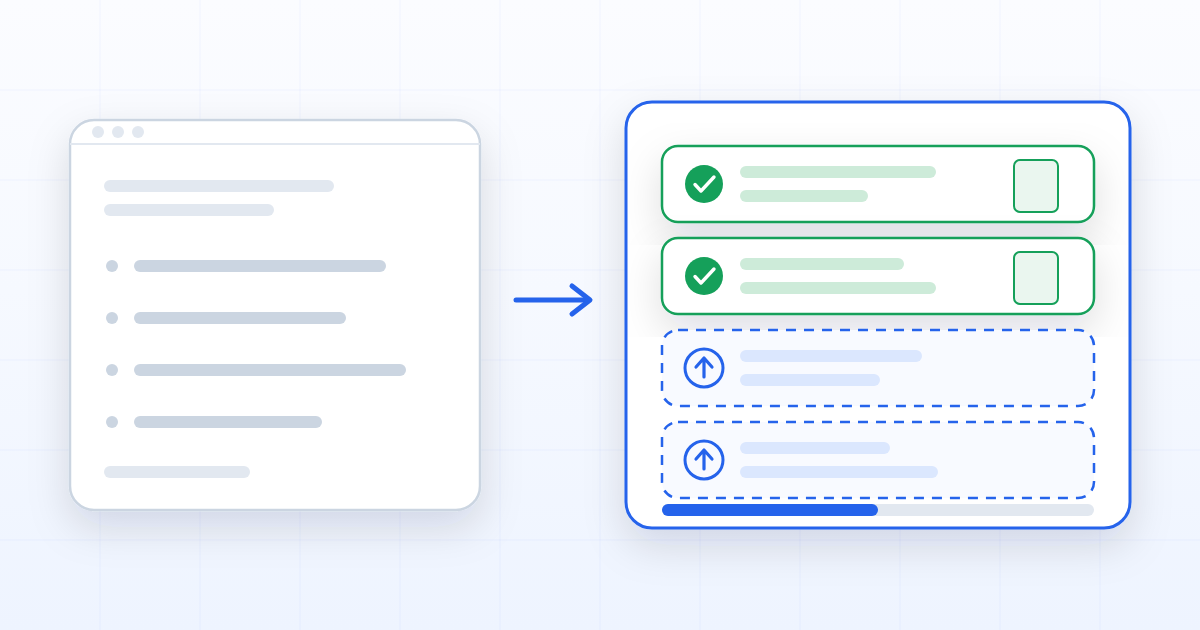
A shop is arranging instalment finance for a customer. The finance partner needs six things: identity, proof of address, three months of payslips, an IBAN, and a signed mandate.
The normal way to ask for those is an email that lists them. It is also the reason this takes eleven days.
What the email actually costs
The customer reads the list once, on a phone, and then works from memory. Three attachments come back in one reply, two more in another the next day, one of them is the wrong month, and the sixth never arrives at all. Somebody in the shop keeps a mental note of what is still outstanding, or a note in a spreadsheet, and sends a chaser that says "we are still missing a couple of things" because writing out which ones takes five minutes they do not have.
Every one of those problems is the same problem: the list and the documents live in different places, and only a person is holding them together.
The alternative is not a portal
The reflex is to build a customer portal — accounts, passwords, a dashboard, a password-reset flow, a support burden, and a login screen standing between a customer and a task that should take four minutes.
What is actually needed is narrower: a link to this one dossier, for this one customer, that expires. No account is created. The person on the other end exists, as far as the system is concerned, as the email address the invitation was sent to — not as a phantom user quietly added to your team model, which is exactly the kind of shortcut that later shows up in a permissions report nobody can explain.
What the customer opens
Not a list. The dossier, prepared:
- A slot for each required document, labelled with what it is, showing which are already satisfied and which are still waiting.
- The fields that go with them — the IBAN, the employer's name — as fields, not as instructions saying "please include your IBAN in the body of the email".
- Its own state: two of six, then four of six, updating as things arrive.
The customer uploads a payslip into the payslip slot. They cannot upload it into the wrong place, because the wrong place is not offered. And when they close the tab and come back tomorrow, they see what is left rather than trying to reconstruct it from an email thread.
Nobody in the shop is holding anything together, because there is nothing to hold: the list is the dossier.
The rules that make it safe to send
Sharing a case outside the organisation is where document systems tend to acquire their worst accidents, so it is worth being explicit about the constraints.
The unit of sharing is the whole dossier. There is no per-document permission, deliberately. It sounds like a limitation and it is a design decision: per-document ACLs are the feature that makes it impossible, a year later, to answer "who can see this". A case that needs to share less is a case with less in it.
Only a dossier marked shareable can be shared, and it is checked continuously. Not only when the link is created. If somebody later raises the confidentiality of that case, its outstanding links are revoked in the same operation that raises it. The alternative — a link minted last month against a case that has since become restricted — is precisely the leak nobody discovers.
The link is a token, and the system stores only its hash. What is in the database cannot be used to open anything. That matters on the day somebody has read access to a backup.
It expires, it can be revoked, and it can be resent. Three separate things, and a system that offers only the first makes people share their own screenshots instead.
Rate limits and upload quotas apply. An address on the public internet that accepts files is an address that will be found; the limits are what stop it becoming somebody's free storage.
What the shop gets that it did not ask for
The reason to do this is the eleven days becoming two. What comes with it is the part that gets noticed later:
The chasing stops being manual, because the case knows what is missing and can say so on its own. The record of who uploaded what, and when, is a record rather than an email folder. And when the finance partner asks why an application was approved, the answer is the dossier as it stood at the moment of the decision — including the payslip that arrived on the Tuesday.
None of that was the goal. It is what you get for free once the list and the documents stop being two different things.