
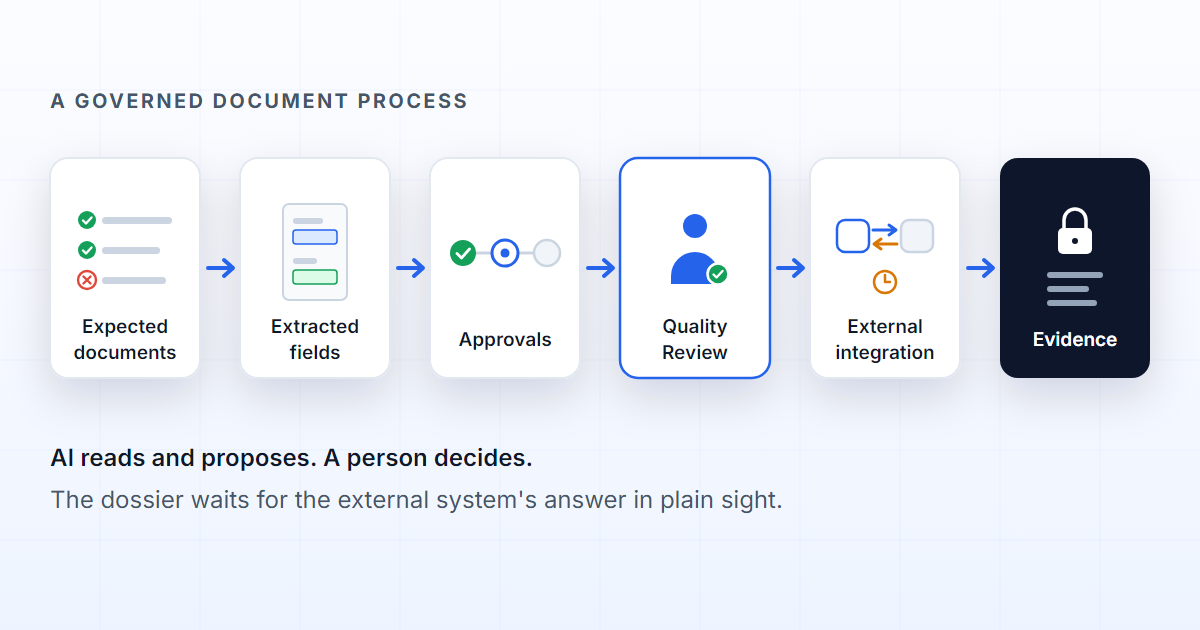
A well-designed document process does not start with a folder. It starts with a question: which decision does the organisation need to take, which documents prove that decision, and who has to validate each part before it moves on? Designing the process means answering that in writing and putting the answers inside the workflow, where they cannot be skipped.
Many teams treat documents as attachments: they arrive by email, sit in a folder structure, and the state of the process is tracked in a spreadsheet. At low volume it works. At volume, nobody knows for certain which document is missing, which version was validated, who approved what or whether the external system has been updated yet, because each answer lives somewhere different and none of them is the process.
In DOK Genius the document process is a governed sequence: every dossier is born from a process that defines the expected documents, the data to collect, the rules that block submission, the approvals, the human review and the external operation that closes the loop. The features page gives the overview; what follows is how to think before configuring one.
What a modern document process should contain
A complete document process answers seven practical questions:
- What outcome do we want?
- Which documents are mandatory, optional or conditional?
- Which data has to be extracted or confirmed?
- Who may see, upload, validate or approve each document?
- Which situations must be reviewed by a person?
- Which external system has to receive the result?
- What evidence must remain available for audit?
An example: onboarding a new supplier, which ends with the supplier created in the ERP. The tax clearance certificate, the proof of bank account and the signed contract are mandatory; liability insurance is required only from suppliers who work on the premises. The tax number and the certificate's validity date are confirmed. Procurement approves first and the finance director second; a person reviews the case when the reading of the certificate is not confident enough; and the record keeps who uploaded, who approved, what the AI read and which reference the ERP returned.
When these decisions live in informal instructions, every person reads the process their own way. When they live in the process, a dossier that does not meet them does not move.
From template to real dossier
The process works as an operational template. When a dossier is created, DOK Genius materialises the expected structure: documents, fields, checklist, approvers, review rules and decision points. A newly created dossier is not empty: it is the list of what is missing, as what a dossier actually is explains.
Each expected document has a status of its own — missing, partial, uploaded, validated, needs correction or expired — separate from the dossier's lifecycle. The team sees progress without opening a folder, and a submission with a mandatory document missing is refused, with the document's name. The dossiers chapter walks through that screen.
Approvals and human review
Not every decision should be automatic. AI can extract text, suggest classifications, find inconsistencies and prepare an analysis; there are moments when the organisation needs a human confirmation. A good design distinguishes two kinds of it.
An approval is a business decision: should we go ahead with this dossier? Approvers form an ordered chain — the second is only asked after the first has approved, and at any moment there is exactly one person the dossier is waiting for. A rejection reopens the dossier and resets the chain: the earlier approvals were given against a version that no longer exists. The approvals chapter and the article on approval chains develop the subject.
Quality Review is a decision about the reading: is what the AI extracted correct, and is it the right document? A dossier reaches this queue when the process requires it, or when an attachment raises an exception, such as confidence below the threshold. The reviewer approves, returns for correction or rejects with a reason; the AI's suggestion never overrides the human decision. The chapter on Quality Review describes the queue and the three decisions. The goal is not to take people out of the process, but to have them step in at the right moment.
External integrations without losing traceability
Many document processes end outside the platform: in an ERP, a CRM, an insurance system, a financial back office. A correct design anticipates when and how that integration happens — and what is done when it goes wrong.
In DOK Genius the external operation is part of the dossier's lifecycle: while the operation is sent and the other system's answer is awaited, the dossier sits in a state of its own, in plain sight. If the operation fails, the dossier is marked failed with the reason visible, and the operation can be repeated or the dossier reopened for correction. If it completes, the dossier closes with the reference the external system returned — when, with which data and from which documents. The integrations page explains the connections to other systems.
Why this matters for AI
Document AI is only trustworthy inside a governed context. A model answers better when it knows what kind of process it is handling, which documents were expected, which fields matter and which permissions it has to respect. Without that structure, AI is little more than a search over files: it finds the most similar document, not the right one. With it, AI operates on dossiers with rules, states, evidence and accountability.
FAQ
Does DOK Genius replace a traditional document management tool?
For many processes, yes. The difference is that DOK Genius does not only organise files: it organises the work that depends on them — what is missing, who decides, what the AI read, what the external system answered.
Can a process have mandatory and optional documents?
Yes. Each expected document declares whether it is mandatory, how many files it accepts and whether it has a validity period. Confidentiality per document, inside the same dossier, is on the roadmap.
Does the AI decide on its own?
No. AI reads, extracts, classifies and flags what it is not confident enough to pass on. Decisions stay with people — approvers and reviewers — and they are recorded: who decided, when, and against which version.
Can I integrate the process with external systems?
Yes. The process can end with an external operation, visible in the dossier's lifecycle: in progress, failed with a reason, or completed with the returned reference. An evidence pack exportable from the history is on the roadmap.