
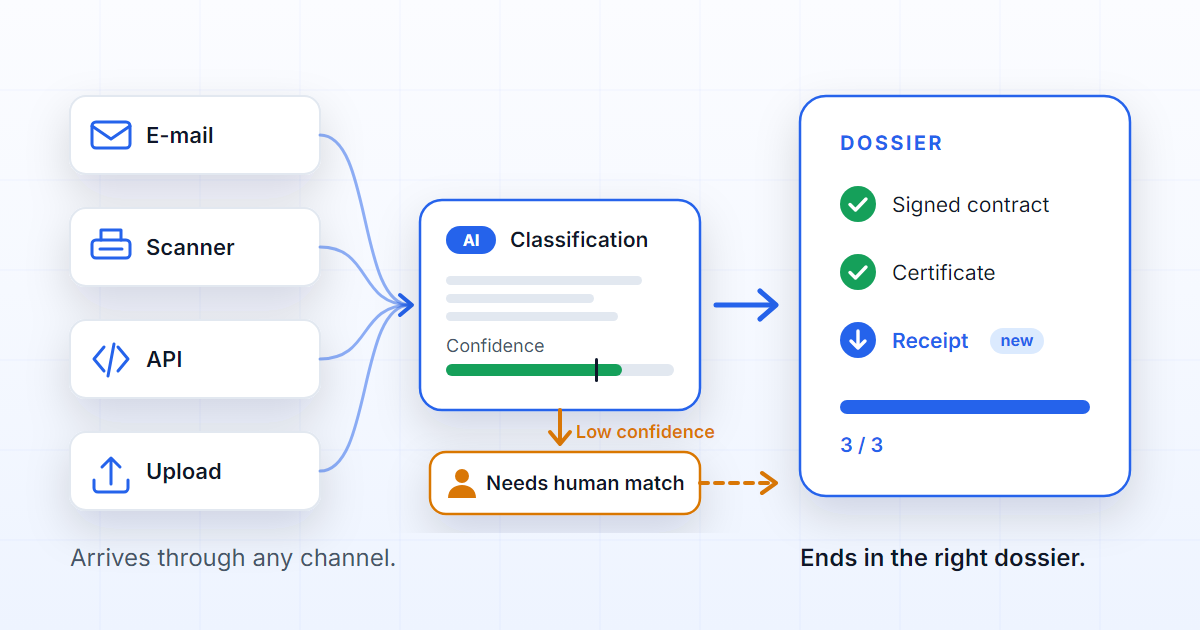
Automating document intake is not just receiving files through several channels. The real challenge is turning each arrival into the right dossier, as the right document, in the right process — without making a person retype data, and without letting the machine decide on its own when confidence falls short. The short answer has four parts: receive through any channel, classify what arrived, route it to the dossier it belongs to, and stop when the match is not clear, so that a person decides.
In a complete flow the document may arrive by e-mail, from a scanner, through an API or by manual upload. From there the system reads the content, identifies the type of document, looks for a matching process and opens or updates the appropriate dossier.
The problem with loose channels
Many organisations receive documents in mailboxes, shared folders, scanners and forms. Each of those channels does well what it was made for: e-mail reaches everybody without installing anything, a scanner turns paper into a file in seconds, a shared folder is easy to explain. The problem is not the channel. It is what happens next, because every channel has its own informal rule.
Somebody reads the e-mail, renames the file, creates a folder, copies data into another system and lets someone know. That work looks administrative, but it is where the errors begin: forgotten attachments, documents in the wrong case, duplicates, versions without context, and decisions taken on incomplete files.
| Channel | What arrives | What is usually missing on arrival |
|---|---|---|
| Attachments, with a sender and a subject | The process and dossier they belong to | |
| Scanner | Pages or batches from several cases | The separation between cases |
| API | A file from another system, with metadata | Confirmation of the metadata |
| Manual upload | A file somebody has in their hand | A decision about where to put it |
In every case, what is missing is the destination. Intake automation is first of all a routing problem, not a storage problem.
What governed intake needs to do
Governed document intake needs four capabilities:
- Receive documents from several channels.
- Classify the type of document and the process it belongs to.
- Route it to the right dossier, or create a new one when the process rule allows it.
- Stop when the match is not clear, and put the document in front of a person.
The fourth matters as much as the other three. Mature automation is not the kind that never asks for help; it is the kind that knows when to ask. A system that routes everything, without exception, has not removed the uncertainty — it has hidden it inside the dossiers, where it surfaces when somebody decides based on the wrong document.
The threshold matters. Too demanding, and almost everything waits for a person: you have bought a queue. Too permissive, and documents land in the wrong cases. The right threshold is a business decision, revisited over time. The same rule holds for people: “when in doubt, leave the document in the intake queue” costs a minute; a dossier created in the wrong place costs far more.
Where AI comes in
AI can read the text, extract fields — a contract number, a registration plate, an expiry date — compare the document with the definitions each process expects, and propose a destination.
But the governance is in the rules around it: the minimum confidence to proceed without review, the mandatory documents of each process, who may see and decide, the history of every step, and how exceptions are handled. When confidence is high, the flow proceeds and the document enters the dossier already as the expected document. When it is not, it waits for a person, who confirms the proposed destination, chooses another one, or discards what was never a case.
The system therefore saves work without turning uncertainty into a silent decision. And the reviewer is not approving every automatic decision out of caution; they look only at the ones the machine flagged as doubtful. That is the difference between a queue that empties and one that only grows. The manual chapter on document intake describes that review queue.
The role of DOK Genius
In DOK Genius, document intake feeds dossiers. The document is not simply filed: it is attached to a process, to an expected document, to states, to validations and to an auditable history. If the difference between a dossier and a folder is not yet clear, this article explains it.
That model is what lets a document received by e-mail and another captured by a scanner end up in the same place, with the same evidence and the same rules: the channel changes, the dossier does not. A complete example, from an e-mail to a filed insurance claim, is in The document arrives first.
Today a document can enter through the API or be uploaded by somebody without choosing a destination, and it follows the same queue of reading, classification and review. Intake from mailboxes and scanners for every organisation is on the roadmap. The features page lists what exists; the roadmap gives the calendar.
FAQ
Does intake automation replace creating dossiers by hand?
It does not replace it; it reverses the order. What changes is that the document can arrive first, before anybody has created the case, and be the thing that opens or updates the right dossier. Manual creation becomes the exception rather than the rule.
What happens when the system is not confident enough?
The document stops and waits for review. A person sees the file and the proposed destination, and confirms, changes or discards it. Nothing is routed on the strength of a weak match, and the human decision is recorded in the history like any other.
Does sending the same document twice create duplicates?
No. Each document that arrives keeps the channel it came through and the identifier the sender gave the delivery, so a replay of the same message adds nothing. A message with three attachments becomes three documents, distinguished by content.
Can I connect my mailbox and my scanner today?
E-mail and scanner intake for every organisation is on the roadmap. Until then, documents enter through the API or by manual upload without a destination, and the rest of the flow is the same one the new channels will feed. The roadmap shows what is planned and for when.