
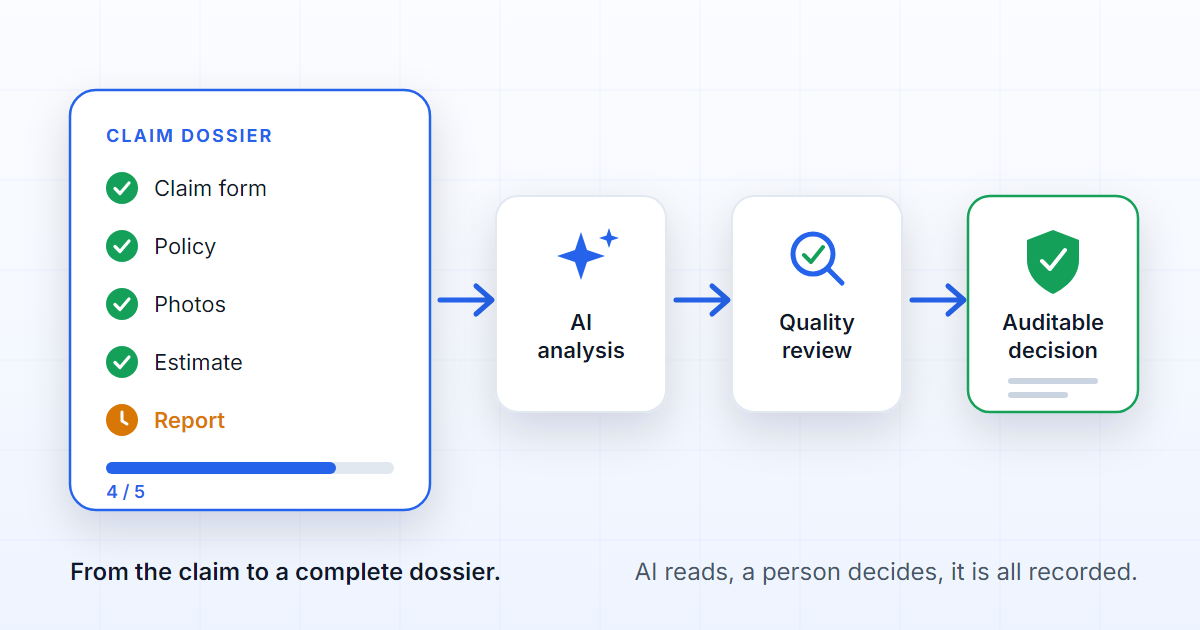
A claim is rarely just a form. It involves claim forms, policies, photographs, repair estimates, loss adjusters' reports, third-party statements, e-mails and internal decisions. When those pieces are scattered, the team rebuilds the context before it can decide anything. The answer is not another folder: it is to treat the claim as a governed dossier — a case that knows in advance which documents it expects, what state each one is in, who validates them and what evidence the decision leaves behind.
DOK Genius was designed to turn that scattered set into a dossier of that kind: each insurance process defines the expected documents, the relevant data, the validations, the people responsible and the review steps before the final decision.
The document problem inside a claim
In many insurance workflows the work does not fail for lack of a system. It fails because documents arrive through different channels and nobody has a simple view of what is missing and what is already validated. The photograph arrives by e-mail, the claim form through the portal, the estimate as a PDF — and somebody has to confirm that the policy was in force on the date of the loss and that each document belongs to the right claim.
A shared folder stores files, a spreadsheet keeps track of a list and e-mail carries an attachment to the person who has to see it. All of them do their job well, and none of them knows what this claim is still missing: that question lives in the handler's head, and leaves with them when they change teams.
How DOK Genius organises the claim
In DOK Genius the claim is a dossier, and the dossier is born from a process. The process declares the documents a case of that kind requires. For a simple motor claim the declaration might look like this:
| Expected document | Mandatory | Files |
|---|---|---|
| Claim form | Yes | 1 |
| Policy in force | Yes | 1 |
| Photographs of the damage | Yes | 1 to 10 |
| Repair estimate | Yes | 1 or more |
| Loss adjuster's report | No | up to 1 |
When the dossier is created these documents exist immediately as entries, before anything is uploaded: an empty dossier is the complete list of what is missing, as What a dossier actually is explains. The declarations are copied into the dossier, not referenced — editing the process tomorrow does not rewrite what was demanded of yesterday's claims.
Each expected document carries its own status — missing, partial, uploaded, validated, needs correction or expired — and that status belongs to the document, not to the case. Submission is blocked while mandatory documentation is missing, and the message says which: “the repair estimate is missing” gives somebody something to do; “the dossier is incomplete” does not. See Working a dossier.
Where AI helps and where it stops
AI speeds up the repetitive work: it reads the text of the files, picks out dates, amounts and policy numbers, suggests a classification for each attachment, summarises long documents and can flag what does not add up, such as a document that is not of the expected type. Instead of hunting through PDFs, the user gets an organised reading of the dossier and can ask Genius about it.
But AI does not replace a responsible decision. DOK Genius pairs the automation with Quality Review: when a value is extracted with low confidence or the process demands human sign-off, the dossier stops in a queue and a person decides — approve, return for correction with a reason, or reject. The human decision always wins over the AI suggestion.
The decision on the claim itself — accept, decline, settle for an amount — remains with the insurer's people and rules. The approvers defined in the process decide in order, and each decision is recorded against the state the dossier was in. See Approvals.
Evidence for audit and internal control
In insurance, a decision has to be explainable: which documents supported it, which data was used, who validated it, which exceptions arose and when the external system was updated. The dossier keeps that line of evidence — every state change, every document validated or returned, every value the AI read and its confidence, every approval and the outcome of the external operation, always with author and date. Operations, compliance and audit review the case in the dossier itself, without reconstructing anything.
Access is part of the evidence. Today each dossier has a base confidentiality level and access follows the structure of the organisation — one branch does not, by default, see another's claims. Per-document confidentiality and an exportable evidence pack for auditors are on the roadmap. See Security.
Integration with the insurance ecosystem
The dossier does not live in isolation: after the analysis and the review, the result has to reach the claims management system, the CRM or billing. In DOK Genius that step is part of the process: an external operation that calls the insurer's system, waits for the answer and records the returned reference on the dossier — the claim number, for instance.
If the call fails, the failure is a state of the dossier, visible and retryable, not a line in a technical log. The full journey is in The document arrives first; the available connections, under Integrations.
FAQ
Does DOK Genius decide claims automatically?
No. DOK Genius organises the documents, supports the analysis with AI, puts a person in the review and creates evidence. The final decision still depends on the insurer's rules and responsibilities, and it is recorded with the name of the person who took it.
Does the platform accept documents received by e-mail or scanner?
That is on the roadmap. Multichannel intake — e-mail, scanner and API — will bring files into a queue where they are read, classified and routed to the right dossier, with a person stepping in only when the classification is uncertain. Today, files enter through direct upload or through a link sent to the policyholder. See Document intake.
Can sensitive documents be restricted within the same claim?
Fine-grained confidentiality per document is on the roadmap: a clinical report will be able to carry its own rules inside the same dossier, and somebody without the required level will see that the document exists without seeing its content. Today, confidentiality applies to the whole dossier and to the structure of the organisation.