
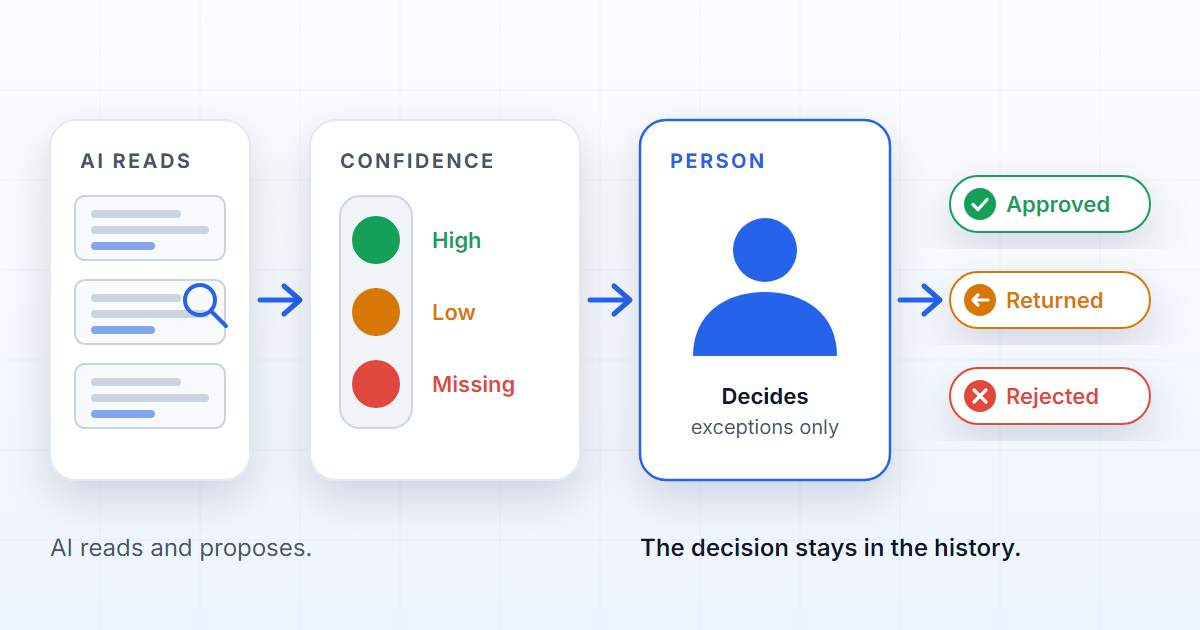
Human-in-the-loop, in document AI, is the design in which the machine reads and a person decides at the points where the risk calls for judgement. The best document AI is not the one that pretends never to be wrong. It is the one that knows when it may proceed on its own within rules somebody set, when it must ask for validation, and how to make clear who took the final decision.
In document processes, the risk is rarely just misreading a field. It is letting that field travel into a decision, a payment, an approval or an external system without anyone noticing there was uncertainty.
What human-in-the-loop means
Human-in-the-loop is the design in which AI does the operational work — reading, classification, extraction, comparison — but a person steps in at the points where the risk calls for judgement. It is not manual review of everything, which cancels out the automation. Nor is it blind automation, which trades a queue of work for a queue of surprises.
It is an explicit boundary: the machine proposes, or executes within the rules; the person decides when the confidence of the reading, the type of document or the consequence of the next step make that necessary. The boundary is written into the process, not kept in the head of whoever is on duty that day.
Why this matters for documents
Documents have context, and reading a field correctly is not the same as reading the document correctly. A certificate can be legible and still be expired. A contract can carry the right name and lack a signature. A receipt can be genuine and belong to another case. An extracted value can look plausible and have been read from the wrong page.
AI speeds up the detection of those points. What it cannot do for the organisation is take responsibility for what follows: the organisation needs to know when it accepted the suggestion and who validated it. Without that, "the AI did it" becomes the explanation for any decision that went wrong.
Quality Review as the mechanism
In DOK Genius, Quality Review is the queue where AI results that need human validation stop before the dossier moves on to an external operation or to completion. A dossier gets there by one of two routes:
- The process requires review. A process can require review always; every dossier of that kind then stops in the queue.
- An attachment raised an exception. Even with global review switched off, the dossier stops when an attachment needs a human decision: unexpected document type, confidence below the threshold set for the process, missing confidence, or another risk signal.
A technical failure is not a review exception: if the AI service, the text recognition or an integration fails, the dossier goes to a failed state, from which it can be recovered or repeated.
Each analysed attachment shows the AI result, the confidence and the exception that brought it there. The reviewer takes one of three decisions about the dossier:
| Decision | When | What happens next |
|---|---|---|
| Approve | The results are correct and every attachment with an exception has been decided | The dossier enters the configured external operation or is completed |
| Return for correction | Attachments are wrong or incomplete and somebody has to correct them | The dossier reopens with the correction scope — the rejected attachments — and a mandatory reason |
| Reject | The AI result should not be used, and this is not a simple attachment correction | The dossier goes to a failed state, with the mandatory reason visible |
The reviewer is not "doing the AI's work". They are closing the decision the AI should not close on its own, with a reason that guides whoever comes next. The Quality Review manual describes the screen and what to check first.
DOK Genius does not take autonomous decisions about a dossier: approving, returning and rejecting are always the acts of a person, with author and reason recorded.
How to recognise a good design
A good human-in-the-loop flow has five signs:
- It shows the confidence and the reason for the exception. "Low confidence on the expiry date" is information; an attachment in the queue with no explanation is a guessing game.
- It separates the automatic suggestion from the human decision. The value the AI proposed and the value the person accepted are two facts, kept distinct in the record.
- It requires a reason when somebody returns or rejects. The reason is the instruction for whoever corrects. "The date was read from the wrong page" resolves it; "wrong" does not.
- It records the decision in the history. Who decided, when and on what grounds: it is what an audit will want to read, which is why it is part of the product's security.
- It routes the dossier to the next step without duplicate work. Approval takes it to the external operation or to completion; a return takes it to correction with the right scope.
The features of DOK Genius — processes, dossiers, approvals, history — exist so that the AI has somewhere to stop. The same logic applies upstream, in why your AI assistant answers with the wrong document.
AI makes the process faster. Human review makes the result acceptable.
FAQ
Does human-in-the-loop mean reviewing every document?
No. Reviewing everything cancels out the automation and shifts the fatigue onto the reviewer, who starts approving out of habit. The right design defines, per process, what may proceed within the rules and what has to stop: mandatory review when the consequence justifies it, review by exception otherwise.
What happens when the AI has low confidence in a field?
The attachment raises an exception and the dossier stops in Quality Review, even if the process does not require global review. The queue shows the lowest confidence found, not the average, because a single misread field can be the one that compromises the decision. Until a person decides, the value does not move on to an approval or to an external system.
Who takes the final decision, the AI or the person?
Always the person. AI reads, extracts, classifies and flags; approving, returning or rejecting is a human act, with author, date and reason in the dossier's history. When a dossier moves on without passing through the queue, it is because whoever configured the process decided in advance that a case with no exceptions could proceed.